
Blog
News & commentary on AMICAL’s projects and activities
Jeff Gima ·
1 December 2017
Small Grants reopened with new guidelines – next deadline 10 December

I’m pleased to announce that we’ve just reopened AMICAL’s Small Grants program for new applications. The program was closed briefly while we revised the guidelines based on feedback from the Grant Review Committee and AMICAL Administration’s observations of previous applications and activity reports.
Among other things, the new guidelines bear the following improvements:
Less emphasis is placed on previous AMICAL involvement: new participants are strongly encouraged!
Staff exchanges and peer training have been distinguished from other (external) forms of professional development activity, and we’ve made it clearer how to strengthen, through planning processes, your Small Grants applications for this kind of activity.
We’ve introduced questions that encourage you to think concretely about how activities relate to your own role and will have impact on your institution.
For professional development activities, we’ve emphasized events that are smaller in terms of attendees, but extended in depth and length – and we’ve opened up the possibility of using Small Grants for semester-length online courses.
For projects, we’ve provided clearer guidelines for timelining your plans, along with very brief “check-in” reporting along the way. The goal here is to provide AMICAL Admin with a way to monitor the healthy progress of projects, and to facilitate assistance in cases where a project may be facing difficulties.
The new application form is aligned much more closely with the review criteria, which we hope will make it easier for applicants to build successful proposals – and plan for successful activities.
The next deadline to apply for Small Grants is 10 December, at midnight wherever you happen to be. As a reminder, the program is open to staff and faculty at AMICAL Full and Affiliate member institutions (see the guidelines for full information). If you have any questions about the program, send them to contact@amicalnet.org.
We look forward to seeing your applications!
Special thanks go to the current and previous Grant Review Committees (the elected officers of AMICAL’s Coordinating Committee) for the time and effort spent improving the Small Grants program through their feedback.
Elisabetta Morani ·
8 November 2017
ICOLC Europe and Knowledge Unlatched

In theory, I fully support the idea of struggling against the unbelievable, unaffordable prices that I see every day, and, even better, making knowledge available to all.
But being in a small, teaching institution where faculty face the “publish or perish” alternative in a quite traditional manner, I’ve always felt that there was little to do. The open access movement has been for me a noble initiative, shining at distance like a beautiful moon.
Attending the European meetings of ICOLC on behalf of AMICAL in 2016
and 2017 has been like landing on that moon. The kingdom of Gold Open
Access.
Sustained by EU policy
and belonging to big national consortia, the visionary participants to
ICOLC Europe are fully involved in open access negotiations, aiming to
make the entire research output of their home countries publicly
accessible. Moreover, not satisfied with the current pace of open access
publishing initiatives, many European institutions started urging for a
faster, global transition, planning to
make it happen by 2020.
Dr Ralf Schimmer (Max Planck Digital Library) says:
Our
regular subscription focus with its limitation to read access
privileges is just not good enough anymore. Publishing and reading are
but two side of the same medal. They are interrelated and need to be
combined in our service level agreements with the publishers.
Three years from now? Are they crazy? And what if they are right? And above all, what can AMICAL do here?
AMICAL
is not a big national consortium and doesn’t have the power of
negotiating open access agreements with publishers. Yet, it could do
something.
Inspired by the preceding experiences of a couple of member institutions, the Electronic Resource Committee approached Knowledge Unlatched
(KU), whose mission is to work with libraries and publishers to promote
open access for books and journals in the humanities and social
sciences.
Every year since 2014 KU has been selecting and
submitting to libraries a well selected list of scholarly titles. By
participating in the pledge, libraries commit to pay the cost of
publishing these titles with Creative Commons licenses. To this day, KU
has already secured open access for 443 monographs.
Helped by a
generous consortial offer, a small squad of five AMICAL member
institutions has just landed in open access territory by signing the KU
2017 pledges for both
books and journals.
If successful, the American University in Bulgaria, the American University of Kuwait, the American University of Paris, Ashesi University College, and John Cabot University – together with many other libraries will
“liberate” a pouch of 343 monographs and 21 journals selected by 40
librarians from 12 countries.
For everyone, everywhere. Fingers crossed, Knowledge Unlatched!
The KU pledge is open until November 30. Details for the offer to AMICAL libraries are in Connect. Join the squad, AMICAL friends!
Jeff Gima ·
20 October 2017
AMICAL 2018: 4-7 May at the American University of Central Asia
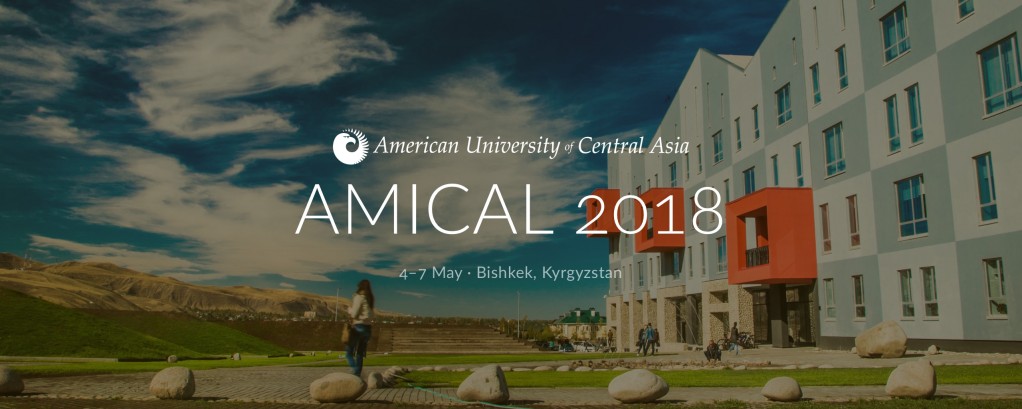
Mark your calendars for 4-7 May 2018! The American University of Central Asia has graciously agreed to host our next AMICAL Conference, and we hope to have as many AMICAL colleagues as possible join us for the event, whether in person or online.
What’s in the future for education at international liberal arts institutions? What’s changing in the ways that students and faculty acquire, use, create and share information and scholarship? This year’s conference will set the stage for AMICAL members to engage with each other and with invited experts on those questions — and on many other questions related to libraries, technology and learning at our member institutions.
Basic information about the event is provided on our just-launched AMICAL 2018 page. Information for sponsor-exhibitors will be posted shortly. We’ll launch the full event site later this fall with an overview of anticipated features of the program, a call for proposals, and information about financial support, accommodations and the venue.
In the meantime, visit the AMICAL 2018 page to find out how you can send suggestions for shaping the program and how to stay in touch with conference updates.
Jeff Gima ·
11 October 2017
AMICAL is sending a cohort to the Digital Humanities Summer Institute
In a recent AMICAL survey, Chief Academic Officers told us that developing capacity for the digital humanities at member institutions was, on average, one of the “High importance” areas of our consortial work. Our current A.W. Mellon Foundation grant is enabling us to get started on that this year. We’ll be supporting the coordinated participation of a cohort of AMICAL members in DHSI 2018, the Digital Humanities Summer Institute to be held in June 2018 at the University of Victoria, in British Columbia, Canada.
Are you, or your colleagues, developing a project related to digital humanities scholarship, pedagogy or resources at an AMICAL member institution? DHSI may offer courses relevant to your project, and participating as part of AMICAL’s cohort is an opportunity to maximize the benefit of DHSI while building a peer network that will be useful now and in the future.
Chief Academic Officers at AMICAL institutions have received an announcement about this initiative, encouraging them to identify a local team to endorse their application. If you have a team or project that matches what we’re looking for in applicants, and you’d like to join us for DHSI, get in touch with your provost or dean to let them know you’re thinking about applying. Keep in mind that they’re only allowed to endorse one team from your institution.
AMICAL members: Build your team and apply
Here’s what you can do to get a team from your institution into our DHSI cohort:
Share this message with deans, faculty, librarians or technologists who might be interested in joining our cohort as a project-based team.
Review the AMICAL DHSI Cohort website, paying close attention to the criteria for teams and applications under Who should apply? and How to apply.
Discuss your team and project with your provost/dean, so they’re aware that you’ll be requesting endorsement of your application.
Complete the application form.
Send your completed application form to your provost/dean, asking them to endorse and forward your application to AMICAL by 31 October.
Financial support
Endorsement by your provost/dean does not guarantee your team will be accepted for the cohort, since our grant resources limit the numbers we can support, and since our application criteria may give higher priority to certain kinds of team or project. For applications accepted from Full and Affiliate member institutions, however, AMICAL would fully cover airfare and accommodations. A maximum of one team may be accepted from each institution for financial support. Your institution would need to cover the registration fees. See Costs and co-funding for more information.
Not all applicants can be accepted, but we hope to have as many AMICAL teams as possible joining the cohort. Basic information about the target profiles for applicants is shown below. Full information is on the AMICAL DHSI Cohort website, but any questions can be sent to contact@amicalnet.org.
25 September 2017
Small Grants – September 2017 update

Responses were recently sent out for the latest group of applications for AMICAL’s Small Grant Program.
Of the 8 applications received, the Grant Review Committee accepted the following 6:
Exchange experience: Digitization of university materials and ingesting of faculty publications in university repository [staff exchange]Sawsan Habre, Senior Archivist (Lebanese American University)
Oral history collection development [project]Maria Patsarika, Adjunct Professor, Humanities and Social Sciences Division (American College of Thessaloniki)
Harvard’s Leadership Institute for Academic Librarians [professional development]Aziz El Hassani, Multimedia Librarian (Al Akhawayn University in Ifrane)
EDUCAUSE Annual Conference [professional development]Rayane Fayed & Rana AlGhazzi (American University of Beirut)
Building data analysis and hosting capacity at AUCA [project]Meghan McCormack, Associate Professor (American University of Central Asia)
AKYN: Analysing Kyrgyz narratives [project]Anguelina Popova, CTLT Director (American University of Central Asia)
Next deadline for applications: 5 November
The next round of applications will close at midnight on 5 November. Applicants must be from Full or Affiliate member institutions.
Find out more
Full information, including the criteria we use in evaluating applications, can be found in our Small Grants guidelines.
Alex Armstrong & Jeff Gima ·
21 July 2017
Year in review: 2016–2017

Now that the summer is finally upon us, we’d like to take a look back over the previous year to highlight just some of the recent events and projects supported by AMICAL. Their success reflects the increasing breadth and enthusiasm of participation across the faculty, librarians and technologists of our consortium.
Our programs are shaped around the following strategic focus areas:
curriculum-integrated digital initiativesinformation literacyleadership of libraries and technology servicescooperative acquisition of library resourcesbuilding faculty & staff communities of practice
We work on those areas primarily through our faculty & staff development events, through our Small Grants, and through our online community platforms and collaboration tools. The fruits of these efforts provide some of the material and inspiration for the AMICAL Conference, the annual gathering of our members.
Curriculum-integrated digital initiatives
DHI-B: Digital Humanities Institute – Beirut 2017
This three-day series of workshops and mini-courses provided hands-on digital humanities training with a regional focus. The Institute was founded on the principles of co-learning and co-teaching among a community of faculty, librarians and instructional design staff. The event helped participants coalesce around a consortial community of practice in digital scholarship. Other outcomes include a panel session at AMICAL 2017 and plans to nurture this nascent community by the Digital Scholarship Committee, which organized this event.
Small grants for projects & staff exchanges
Seven small grants were awarded to five institutions working on digital projects. They ranged from digitization projects of various stripes, including text encoding, to student audio storytelling, and more.
AUCA digital collections (American University of Central Asia)
Creating a corpus of multilingual TEI XML transcriptions from the Linguistic Landscapes of Beirut Project (American University of Beirut)
Digital Radioactive Security (American University of Central Asia)
Digital humanities workshops & consulting at AUP (American University of Paris)
Digitizing Perestroika in Kyrgyzstan (American University of Central Asia)
Podcasting Life 101: AUC Centennial (American University in Cairo)
Thesis repository for the Bissell Library (American College of Thessaloniki)
Information literacy
Co-design: Integrating information literacy into your disciplinary course
In this two-day workshop, Samantha Godbey and Xan Goodman (University of Nevada, Las Vegas) led disciplinary faculty and librarians to collaboratively design course-embedded information literacy activities. Using ACRL’s Framework for Information Literacy for Higher Education, participants developed a course to be taught in the fall of 2017. Organized by the Information Literacy Committee, this event also generated a panel session and a mini-workshop at AMICAL 2017.
Small grants for professional development
Two teaching librarians were awarded small grants to attend ACRL’s Immersion Program, bringing back know-how they can share with colleagues at their institution and across the consortium (American University of Paris & American University of Nigeria).
Leadership of libraries and technology services
Assessing and communicating library contributions to institutional priorities
A two-day intensive workshop for library directors on strategic and sustainable library assessment for academic libraries, led by Kara Malenfant (ACRL) and Karen Brown (Dominican University). This event was organized by the Institutional Research & Assessment Committee, who developed out of it a benchmarking template for AMICAL libraries to benchmark and compare with one another, as well as a mini-workshop for AMICAL 2017.
Small grants
A new library director was awarded a small grant to attend Harvard’s Leadership Institute for Academic Librarians, allowing them to acquire tools and insight for in their new role (American University in Bulgaria).
Cooperative acquisition of library resources
The E-Resources Committee created a new working group, the Library Resources Buyers Group, to allow institutions interested in participating in consortial deals to shape the consortium’s e-resources strategy. One outcome to come from this group was a deal with JSTOR to provide ebooks under a demand-driven acquisition model to participating members with a substantial discount.
Building faculty & staff communities of practice
Small grants funded four staff exchanges among five institutions to establish library collections collaboration, provide digital humanities workshops and consulting, and support faculty development through the work of the teaching and learning centers.
AUC-AUB-LAU library collections collaboration meeting (American University in Cairo, American University of Beirut, Lebanese American University)
Digital humanities workshops & consulting at AUP (American University of Paris)
Support between learning centers to help establish teaching excellence certification and faculty learning communities (American University of Central Asia, American University in Cairo)Faculty development and community media (American University of Central Asia)
Our annual Conference
AMICAL 2017, our most recent annual meeting and conference, was held 17–20 May at the American College of Thessaloniki.
The theme was “Centering on learning: Partnerships and professional development among librarians, faculty and technologists,” and the balance of campus roles among registered attendees reflected that interest in partnership:
48% libraries & archives33% faculty or faculty developers19% instructional designers/technologists or IT managers/staff
The annual AMICAL Conference never fails to generate praise from members. Our favorite this year was from Anguelina Popova, who succinctly summarised what it’s all about:
The AMICAL Conference is a highlight event of the year for me. It’s the place to meet like-minded people with similar academic interests, and exchange on the projects and experiences we have had through the year. It is also an excellent event to start new projects.
The Conference included keynotes on partnerships for information literacy (Christine Susan Bruce) and digital innovation in higher education (Kristen Eshleman). Recordings of the keynotes and other sessions are now available. Sessions with slides (or other resources) available are noted on the conference schedule with an icon – just click through to access the files. Session reports and other discussions are happening in our members-only forum. A summary of the event in selected tweets is on Storify (courtesy of Dimitris Tzouris).
More information
Photos from our events are available on Flickr.
AMICAL members can also read the committee annual reports, which detail their accomplishments for the past year and future goals.
Note: Parts of this blog post were reported earlier in “Program Highlights · Spring 2017”.
Jeff Gima ·
18 July 2017
Candidate list & opening of Coordinating Committee elections

Representatives from Full (voting) Member institutions should have received today an email with the link they must use to cast one ballot on behalf of their institution. It’s a unique URL, which can only be used to submit one ballot, so it’s important not to forward that link to anyone. (The message will come from “invitations@app.electionbuddy.com”, and the platform we’re using is electionbuddy, a widely used platform for secure and anonymous online elections.)
Anyone may view the list of candidates to read their statements and bios. The Full Member reps themselves can also click the ballot link they’ve received to view the candidate information, and they may open the link again later as long as they have not yet submitted their ballot on the electionbuddy platform.
The candidates were presented with “The role of the Coordinating Committee” below and asked to state, in 100 words or less:
why you are qualified to provide this form of leadership for AMICAL
in what ways you would contribute to the advancement of the Coordinating Committee’s work, and toward AMICAL’s mission and goals mentioned below
Before casting their vote for the 4 candidates of their choice, Full Member reps should discuss the candidates and their merits with local colleagues, including any librarians, technologists, faculty, or administrators that may have a stake in AMICAL’s activities.
“The Local AMICAL Representative plays a pivotal role in advancing AMICAL’s mission, and promoting the consortium and its spirit of collaboration as a group, by representing the member institution’s stakeholders, be they librarians, technologists, faculty, or administrators.”
(from Article IV, AMICAL Consortium Operational Guidelines)
Thanks to the Elections Committee (Elisabetta Morani, Asma Al-Kanan, Cendrella Habre) for shepherding this process, to Alex Armstrong for rolling out the communications and election mechanisms, and to all of the candidates for agreeing to stand.
AMICAL Full Members: mark your calendars for the voting deadline of 31 August!
The role of the Coordinating Committee
Coordinating Committee officers are charged with financial and operational oversight, approving policies and directions for the consortium’s activities.
The guiding principles for this work come from
AMICAL’s mission (described on our website)
our grant-funded goals (outlined for the current period under “AMICAL’s 2015-2018 Mellon grant” in this blog post from 2015)
other long-term goals that the Coordinating Committee or Members Council have identified
Practically speaking, the work of Coordinating Committee officers often includes
organization and documentation of periodic meetings, discussions and decisions
assisting AMICAL Administration with the development of policies for grant-supported programs (types and distribution of funding for the annual conference, criteria for vetting applications, etc.)
reviewing applications for our competitive grant-funded programs (Small Grants, Workshop Grants, etc.)
gathering ideas for, and feedback on, new grant development
developing or clarifying long-term member-funded goals
reviewing and acting on applications for membership in the consortium
reviewing, and deciding on appropriate actions for, short to medium-term (not more than 2-year level) strengths, weaknesses, opportunities and threats for the consortium
participating in temporary, ad hoc committees relevant to their expertise to accomplish specific short-term projects
Alex Armstrong ·
22 June 2017
Help shape AMICAL’s Coordinating Committee

As announced at the AMICAL 2017 Members Council, this summer we’re electing officers for AMICAL’s Coordinating Committee.
What exactly is the Coordinating Committee?
The role of the Coordinating Committee is to provide financial and operational oversight, approving policies and directions for the consortium’s activities. The committee is comprised of five officers, four of which are elected and the other being the Consortium Director, as well as the chair of each Standing Committee. The five officers are voting members, while the chairs serve in an ex-officio advisory capacity.
How can I nominate someone?
We are currently in the process of nominating fellow AMICAL members, who will stand for election later this summer, to determine the four elected officers of the next Coordinating Committee. The only restriction for candidates is that they must be affiliated with a Full Member institution.
Nominees will be submitted by each institution’s AMICAL representative. (They have already received instructions for how to do so.) If you have someone you’d like to nominate, you must request from an AMICAL representative to submit them on your behalf. Note that you must confirm with candidates that they are willing to stand for election before nominating them.
The deadline for nominations is June 30.
When will the elections take place?
On July 3, the 2017 Election Committee will collate all the nominees and check with AMICAL representatives to make sure there are no errors or omissions. They will then ask nominees to provide them with brief bios and statements. Once these are gathered, the committee will send out a voting link to eligible representatives, with a deadline of August 31.
The Operational Guidelines describe the election process as follows:
Each Full Member shall vote for one person for each of the elected seats on the Coordinating Committee. … The candidates with the greatest number of votes shall be elected. In the event of a tie, a new ballot will be held for the tied candidates. The new officers will assign themselves the charges.
But for now, there’s still a week to nominate fellow colleagues to this important role!
Posted on behalf of the 2017 Election CommitteeAsma Al-Kanan (American University of Kuwait)Cendrella Habre (American University of Beirut)Elisabetta Morani (John Cabot University)
Jeff Gima ·
9 June 2017
Small Grants – June 2017 update
Responses were recently sent out for the latest group of applications for AMICAL’s Small Grant Program. Of the 7 applications received, the Grant Review Committee accepted the following 5:
Name
Job title
AMICAL institution
Small Grant title
Nikolina Ivanova-Bell
Library Director
American University in Bulgaria
2017 Harvard’s Leadership Institute for Academic Librarians
Najla Jarkas
Senior Lecturer
American University of Beirut
Stylometry Workshop at the 8th European Summer University in Digital Humanities, July 18-28, 2017, Leipzig.
Zheenbek Kulenbekov
Program Coordinator
American University of Central Asia
Digital Radioactive Security
Toshka Borisova
Head of Access/Reference
American University in Bulgaria
12th International Conference on Performance Measurement in Libraries, 31 July – 3 August 2017 at Keble College, Oxford
Anguelina Popova
Assistant professor
American University of Central Asia
Faculty development and community media
The Grant Review Committee is composed of the voting members of AMICAL’s Coordinating Committee. In cases where the Small Grant applicant is from the same institution as a member of the Grant Review Committee, the Committee member recuses themselves from discussion and evaluation of that application.
Next deadline for applications: 2 July
The next round of applications will close at midnight on 2 July. Applicants must be from Full or Affiliate member institutions.
Find out more
Full information, including the criteria we use in evaluating applications, can be found in our Small Grant Program guidelines.
Alex Armstrong ·
15 May 2017
Participate in AMICAL 2017 online

AMICAL members, invited speakers and other guests are converging in Thessaloniki this week for AMICAL 2017, our consortium’s annual Conference. We’ve been planning this event for months, and we’re proud of the program we’ve put together.
But what if you aren’t able to attend? Don’t fret! More than any previous AMICAL Conference, we’ve made sure to provide a terrific program for those who want to participate online. There are plenty of ways for you to join us from wherever you happen to be.
The online program for AMICAL 2017 is open to everyone – not only AMICAL members, but also to colleagues around the world.
As an online participant you can:
Watch selected sessions live
Join our keynote speakers at an online-only breakout session
Participate in the online conversation
Watch selected sessions live
This year we’ll be live streaming over eight hours of sessions. The online program will include both keynotes, featuring invited speakers Christine Susan Bruce and Kristen Eshelman, as well as five panel presentations, including more than twenty AMICAL peers. Online participants will be able to ask questions via the chat that, time permitting, the speakers will be able to address.
Live streaming schedule & links →
Join our keynote speakers at an online-only breakout session
We’re partnering with Virtually Connecting again this year to bring online participants together with both keynote speakers for an informal discussion. To join this session, leave a comment on the Virtual Connecting blog or send a Direct Message on Twitter to @vconnecting.
More info about Virtually Connecting →
Participate in the online conversation
We’ll be tweeting with the #amicalnet hashtag. Follow along and tweet with us.
AMICAL members will also be able to join the real-time discussions on AMICAL’s Slack (on channel #amical2017). More in-depth discussions and follow-up after the conference will take place on AMICAL Connect.
Looking forward to see you all online!